


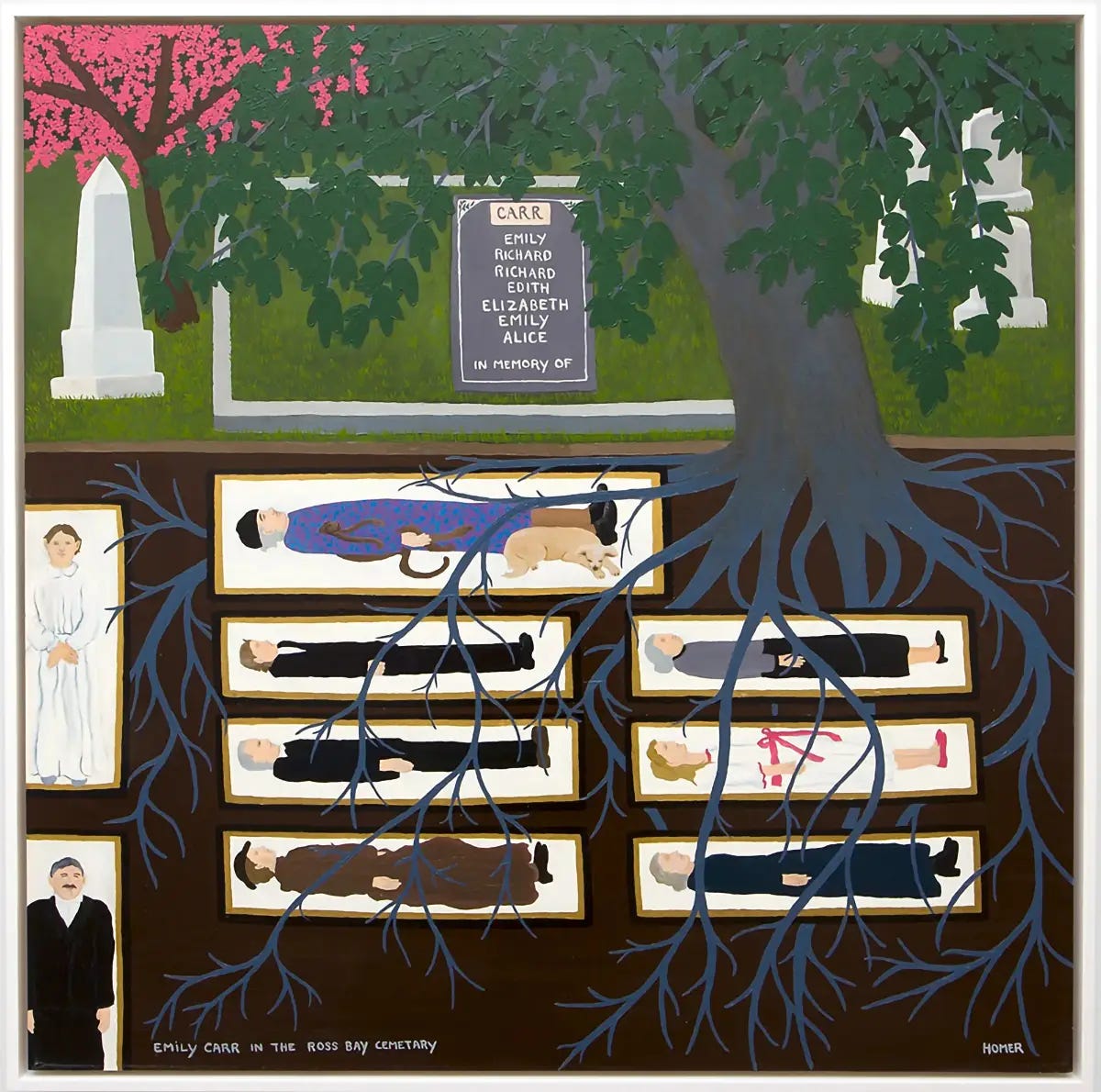
Quand j’ai découvert cette artiste il y a peu, j’ai aussitôt été intrigué (et attiré) par son langage pictural exempt de virtuosité et qui se réduit en quelque sorte à une narration sans bavardage ni fioriture. Évidemment, Jessie Homer French fait penser au Douanier Rousseau et leur style un peu froid où l’affect visuel est souvent réduit au maximum évoque une certaine idée de la mort ou plutôt de la « non-vie ». Pour J. H. F, les sujets y sont aussi bien sûr pour quelque chose.
J’aime particulièrement cette façon de ne pas chercher à tromper les sens. Si réalisme il y a, il n’est pas formel, et cette sémiotique picturale est telle qu’elle m’a incité à me demander si cette Emily Carr qui a donné le titre au tableau a vraiment existé. Et en effet, elle a été l’une des plus grandes artistes peintres canadiennes (née en 1871 et morte en 1945). Ses sujets de prédilection étant sa région, la Colombie-Britannique, la nature et l’art totémique des autochtones. Le cimetière de Ross Bay existe également, il est situé près de Vancouver et à la frontière avec les USA, ou Emily Carr est l’une des personnalités les plus importantes qui y reposent.
Ça fait un bout de chemin entre le sud de la Californie où habite Jessie Homer French et Ross Bay. Y est-elle allée, je n’en sais rien, quoi qu’il en soit, elle s’est indiscutablement documentée. Le personnage qui est représenté (la morte la plus proche de la surface du sol) est assez fidèlement représenté. Sur une photographie d’Emily Carr que l’on peut trouver sur le web, on peut ainsi reconnaître le calot et cette tunique indienne. On voit également sur d’autres photographies qu’elle était souvent accompagnée d’animaux, ce qui expliquerait la présence d’un chien et d’un singe avec elle dans le cercueil (j’ignore cependant si ces animaux s’y trouvent effectivement, je ne suis pas allé aussi loin dans mes recherches).
Photo : JESSIE HOMER FRENCH
Emily Carr in the Ross Bay Cemetery, 2000, 91.44 x 91.44 cm ©Jessie Homer french
When I discovered this artist recently, I was immediately intrigued (and attracted) by her pictorial language, which is devoid of virtuosity and in some ways reduced to a narrative without chitchat or embellishment. Obviously, Jessie Homer French is reminiscent of Douanier Rousseau, and their slightly cold style, in which visual affect is often reduced to a minimum, evokes a certain idea of death, or rather of ‘non-life’. For J. H. F, the subjects also have something to do with it.
I particularly like this way of not trying to deceive the senses. If there is realism, it is not formal, and this pictorial semiotics is such that it prompted me to wonder whether the Emily Carr who gave the painting its title really existed. And indeed, she was one of Canada's greatest painters (born in 1871, died in 1945). Her favourite subjects were her region, British Columbia, nature and Aboriginal totem art. There is also the Ross Bay cemetery, near Vancouver on the border with the USA, where Emily Carr is one of the most important figures buried.
It's a long way from Southern California, where Jessie Homer French lives, to Ross Bay. I don't know whether she went there or not, but whatever the case, she certainly did her homework. The figure depicted (the dead woman closest to the surface of the ground) is fairly faithfully represented. In a photograph of Emily Carr that can be found on the web, the Indian cap and tunic can be recognised. Other photographs also show that she was often accompanied by animals, which would explain the presence of a dog and a monkey with her in the coffin (although I don't know whether these animals are actually there, I haven't researched that far).