


(English version below)
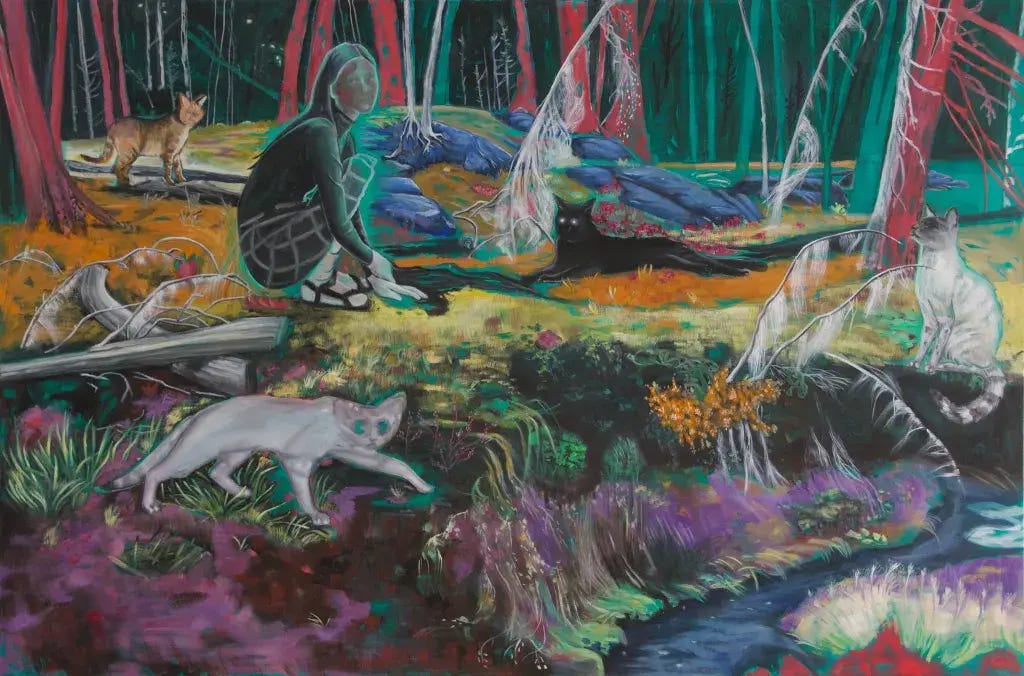
Dernièrement, je me suis intéressé à huit peintures de Domitille Ortès réalisées entre 2021 et 2024, du même format horizontal : 130 x 195 cm et que l’artiste a classés dans la série « paysages » et c’est précisément cette classification qui a retenu mon attention.
Ce que je connaissais, jusqu’alors du travail de Domitille, dans les peintures comme dans les dessins était sa façon de mettre en situation — en postures plus exactement — des personnages tout à fait singuliers et où l’intérêt résidait dans ce qu’ils faisaient ou semblaient faire au point que pour certaines œuvres le « fond » était pratiquement inexistant. Il y eut un peu plus tard quelques changements avec l’apparition dans plusieurs peintures d’un « arrière-plan » significatif comme dans la série Familles ou dans celles où le spectateur se retrouve en quelque sorte dans le rôle d’un photographe immortalisant des personnages dans un décor extérieur dont on ne perçoit qu’une portion (De quel côté trouve-t-on les palourdes ? 2019 ; Souvenir, souvenir, 2019). Dans ces œuvres, ce sont toujours les individus et leurs comportements qui sont mis en valeur, le sujet, c’est eux, même si l’environnement prend une part plus importante et que l’œil doive composer avec lui bien plus qu’auparavant.
C’est en 2021 que j’ai décelé un changement avec notamment ces huit grandes toiles de format identique éminemment différentes des autres étant donné que cette fois le sujet principal est bel et bien le paysage plutôt que les individus qui s’y trouvent. L’artiste a d’ailleurs intitulé cette série « paysages » ce qui n’est pas sans conséquence pour le spectateur. Même s’il y avait eu des prémices dans certaines précédentes peintures avec un traitement plus affirmé du décor, Domitille n’avait pas sauté le pas et changé à ce point d’argument en privilégiant l’environnement dans lequel évoluent ses personnages. L’effet est saisissant, mais qu’on ne s’y trompe pas, il y a bien une continuité avec les précédentes œuvres, nous y reviendrons. Intéressons-nous, d’abord, à l’idée plus général de « paysage » qui fut au début dans l’histoire de l’art la vue par la fenêtre des peintres flamands ou italiens et qui du védutisme initial (paysages essentiellement urbains ou suburbains) s’est peu à peu étendu en dehors des murs de la ville jusqu’à faire sortir plusieurs siècles plus tard l’artiste de son atelier pour le transporter sur le motif. Notons qu’avant cela, la représentation panoramique d’espaces extérieurs était si peu commune que ce n’est qu’en 1680 que le paysage a été défini dans les dictionnaires comme une « figuration picturale ou graphique d’une étendue de pays où la nature tient le premier rôle et où les figures (d’hommes ou d’animaux) et les constructions (“fabriques”) sont accessoires ».
On peut évidemment s’interroger sur l’intérêt que les artistes ont eu à un moment donné pour les paysages. Est-ce parce que « la vie imite l’art bien plus que l’art n’imite la vie » comme Oscar Wilde le fait dire à Vivian dans « Le déclin du mensonge » ? Est-ce un besoin de replacer l’individu au centre du monde comme l’ont suggéré les Humanistes ? De fait, il n’existe pas de « paysage » sans un point de vue, c’est-à-dire sans le regard de quelqu’un qui fait l’expérience dudit paysage et le ramène à lui et à sa mesure, en le « déloignant » comme l’écrit Heidegger. Ainsi, voilà l’essentiel : c’est par l’individu qu’existe le paysage ! Le paysage est un sujet anthropocentrique !
Le XIXe siècle, et en particulier la peinture romantique anglaise et allemande nous en a transmis une vision particulière avec la représentation d’une nature sublime et incommensurable (qu’on pense par exemple à Caspar David Friedrich ou à Turner). Cette conception de paysages « état d’âme » associée à une certaine mythologisation de la nature a évidemment un lien avec les réflexions existentielles de l’époque et nombreux sont les artistes qui se sont rapprochés de la nature parce qu’ils la considéraient comme bonne, entière, totale sans défaut ni vice et qui en fin de compte ne pouvait pas être « mal faite ». Je pense en particulier aux pays scandinaves et à des artistes comme Gallen-Kallela (1865-1931), Pekka Halonen (1865-1933) ou Väinö Blomstedt (1871-1947) qui ont cherché à exprimer quelque chose de plus que la simple beauté dans leurs peintures et dans lesquelles les couleurs sont particulièrement chargées de connotations psychologiques. Måneskinn (Clair de lune) de Munch est un bel exemple de cette approche rédemptrice.
Le mode opératoire pour représenter une nature idéelle se trouve également dans les peintures de Domitille. Le choix singulier des couleurs et de leur tonalité stimule l’intelligence perceptive tandis que la construction générale qui est une très grande subtilité donne à voir d’un seul coup d’œil une évidente totalité. C’est en effet le propre du paysage que de s’édifier en limitant l’espace, en excluant certaines parties visibles pour former une unité afin que se constitue la relation entre l’interne et l’externe, entre moi et le monde et on comprend Cézanne quand il expliquait à Vollard que sur le motif il lui suffisait de faire un tout petit pas de côté devant son chevalet pour que toute la peinture soit à refaire.
Chez Domitille, cette limitation se constate par exemple avec la façon dont elle traite le ciel. L’horizon est soit « serré » tout en haut du tableau et découpé par un relief en dent de scie, soit comme fusionné par la couleur à l’ensemble, soit alors inexistant. L’espace ainsi borné devient clos (les arbres participent à cette limitation) et c’est dans cet espace fermé que se constitue le monde qu’il faut par conséquent voir comme un paysage intérieur.
Alors que les peintures précédentes « fonctionnaient » en quelque sorte par divulgation, l’artiste étant simplement le révélateur d’une situation que le spectateur pouvait ou non constater[1] et à laquelle il pouvait ou non lui-même s’identifier, avec ses peintures-paysage, Domitille ne le sollicite pas. Elle s’est détachée du regardeur comme prétexte pour n’être plus en quelque sorte qu’elle-même dans ses toiles et je dois reconnaître que c’est particulièrement puissant. L’incertitude flottante qui accaparait le spectateur auparavant en le forçant à prendre parti n’existe plus, tout est désormais affirmé et désinhibé. Le sentiment de refoulement qui produisait une inquiétante étrangeté a disparu avec la mise à jour de ces paysages (intérieurs) visibles par tous. C’est ici que se trouve selon moi la continuité avec les œuvres précédentes. Cette fois, la porte est grande ouverte et le paysage qui s’étend devant moi, visible par tous, aussi énigmatique qu’il soit me rassure et me fait dire que je suis chez moi…
Dans le rêve, on n’abandonne pas le monde et celui-ci ne nous abandonne pas, au contraire il ne cesse de se montrer. Domitille a confirmé que c’est dans le rêve qu’a été conçue « La rivière qui nous sépare », la première peinture de la série (« Promenons-nous dans les bois » est plutôt à considérer comme une tentative). Les six autres peintures de la série ont elles aussi une dimension onirique évidente et les personnages, la jeune femme, les sœurs et l’enfant sont là pour nous rappeler chez qui nous sommes et qu’il s’agit en effet d’une projection mentale personnelle tandis que les animaux évoquent « l’autre », qui éventuellement peut être le spectateur. Lion, chat, oiseau, papillon, cheval, sanglier sont autant « d’animalité » dans un espace fantasmé si ce n’est — et c’est le plus important — qu’il ne s’agit pas dans ce monde d’échapper à l’emprise de la réalité, mais plutôt d’en constituer une autre, toute différente, plus grande, plus humaine et probablement plus utile également, je veux parler de la réalité de l’art.
[1] En 2020 j’écrivais dans le texte de l’exposition Heaven « Elle laisse le soin au spectateur de pousser ou non la porte »
Texte écrit en avril 2024
Image : D. Ortes, Hécate et ses chats (huile sur toile 130×195 cm, 2021) ©Domitille
Domitille Ortès / Every tree stands in thought
Lately I’ve been interested in eight paintings by Domitille Ortès, produced between 2021 and 2024, in the same horizontal format: 130 x 195 cm, which the artist has classified as part of the ‘landscapes’ series, and it’s precisely this classification that caught my attention.
What I knew of Domitille’s work up until then, in both her paintings and drawings, was her way of placing in situation – in postures to be precise – characters who were completely singular and where the interest lay in what they were doing or seemed to be doing, to the point where in some works the ‘background’ was practically non-existent. There were a few changes later on, with the appearance in several paintings of a significant ‘background’, as in the Families series, or in those where the viewer finds himself in the role of a photographer immortalising characters in an exterior setting of which we only perceive a portion (On which side are the clams? 2019; Souvenir, souvenir, 2019). In these works, it is always the individuals and their behaviour that are highlighted, the subject is them, even if the environment plays a more important role and the eye has to deal with it much more than before.
It was in 2021 that I noticed a change, in particular with these eight large canvases of identical format, eminently different from the others in that this time the main subject is the landscape rather than the individuals within it. In fact, the artist has entitled this series ‘Landscapes’, which is not without consequences for the viewer.
Although there had been hints of this in some of her earlier paintings, with a more assertive treatment of the setting, Domitille had not taken the plunge and changed her argument to this extent, giving priority to the environment in which her characters move. The effect is striking, but make no mistake, there is continuity with the previous works, and we’ll come back to that later. First of all, let’s look at the more general idea of ‘landscape’, which in the early days of art history was seen through the window by Flemish or Italian painters, and which gradually spread from the initial ‘védutisme’ (essentially urban or suburban landscapes) outside the walls of the city until, several centuries later, the artist left his studio and went out to paint. It should be noted that prior to this, panoramic representation of outdoor spaces was so uncommon that it was not until 1680 that landscape was defined in dictionaries as a « pictorial or graphic figuration of an expanse of country in which nature plays the leading role and figures (of people or animals) and constructions (‘fabriques’) are incidental ».
We can obviously wonder about the interest that artists have had in landscapes at a given time. Is it because « life imitates art much more than art imitates life », as Oscar Wilde has Vivian say in « The Decline of Lies »? Is it a need to put the individual back at the centre of the world, as the Humanists suggested? In fact, there is no such thing as a ‘landscape’ without a point of view, that is to say, without the gaze of someone who experiences the landscape and brings it back to him and to his measure, by ‘dislodging’ it, as Heidegger wrote. So there you have it: landscape exists through the individual! Landscape is an anthropocentric subject!
The 19th century, and in particular English and German Romantic painting, gave us a particular vision of this, with its depiction of sublime, immeasurable nature (think of Caspar David Friedrich or Turner, for example).
This conception of landscapes as a ‘state of mind’, combined with a certain mythologisation of nature, obviously had something to do with the existential reflections of the time, and many artists drew closer to nature because they considered it to be good, whole, without defect or vice, and which, in the final analysis, could not be ‘badly made’. I’m thinking in particular of the Scandinavian countries and artists like Gallen-Kallela (1865-1931), Pekka Halonen (1865-1933) and Väinö Blomstedt (1871-1947), who sought to express something more than mere beauty in their paintings, in which the colours are particularly charged with psychological connotations. Munch’s Måneskinn (Moonlight) is a fine example of this redemptive approach.
The modus operandi for representing an ideal nature can also be found in Domitille’s paintings. The singular choice of colours and their tonality stimulates the perceptive intelligence, while the general construction, which is very subtle, reveals an obvious totality at a glance. It is in fact the very nature of landscape that it is built up by limiting space, by excluding certain visible parts to form a unity so that the relationship between the internal and the external, between myself and the world, can be established, and we understand Cézanne when he explained to Vollard that all he had to do on the motif was to take a tiny step sideways in front of his easel and the whole painting would have to be redone.
In Domitille’s work, this limitation can be seen, for example, in the way she treats the sky. The horizon is either « squeezed in » at the very top of the painting and cut out by a sawtooth relief, or it is as if merged into the whole by the colour, or it is non-existent. The space thus delimited becomes enclosed (the trees contribute to this delimitation) and it is in this enclosed space that the world is constituted, which must therefore be seen as an interior landscape.
Whereas the previous paintings ‘functioned’ in a way by disclosure, the artist simply revealing a situation that the viewer may or may not have noticed[1] and with which they themselves may or may not identify, with her landscape paintings Domitille does not solicit the viewer. She has detached herself from the viewer as a pretext for being, in a way, only herself in her canvases, and I have to admit that this is particularly powerful. The floating uncertainty that previously gripped the viewer, forcing them to take sides, no longer exists; everything is now assertive and uninhibited. The feeling of repression that produced a disquieting strangeness has disappeared with the uncovering of these (interior) landscapes visible to all. In my opinion, this is where the continuity with the previous works lies. This time, the door is wide open and the landscape stretching out before me, visible to all, as enigmatic as it is, reassures me and makes me say that I’m at home…
In a dream, you don’t abandon the world, and the world doesn’t abandon you; on the contrary, it never stops showing itself. Domitille confirmed that « La rivière qui nous sépare », the first painting in the series, was created in a dream (« Promenons-nous dans les bois » is more of an attempt). The other six paintings in the series also have an obvious dreamlike dimension, and the characters – the young woman, the sisters and the child – are there to remind us of who we are, and that this is indeed a personal mental projection, while the animals evoke the « other », who may well be the viewer. Lion, cat, bird, butterfly, horse, wild boar are all ‘animality’ in a fantasised space, if not – and this is the most important point – that this world is not about escaping the grip of reality, but rather about creating another, completely different, greater, more human and probably more useful too, I’m talking about the reality of art.
Max Torregrossa 2024