


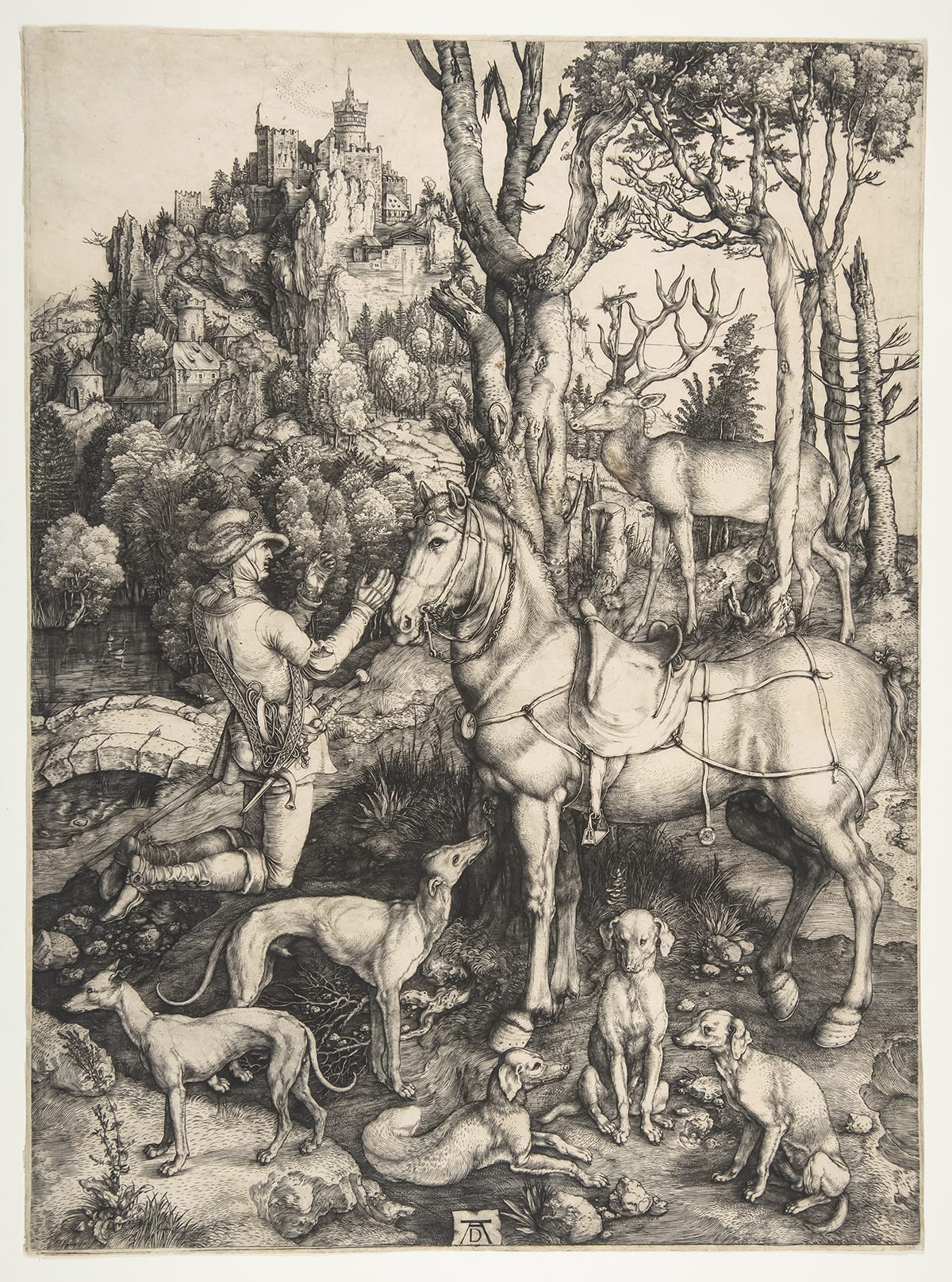
Dans le dernier numéro de The Paris Review (N° 255, printemps 2026), j’ai découvert ce poème d’Inger Christensen (1935 - 2009), femme de lettres danoise, poète, romancière, dramaturge et essayiste, inspiré de la gravure d’Albrecht Dürer « Saint Eustache » réalisée vers 1501. Elle capture le moment miraculeux de la conversion du général romain Placidus, devenu saint Eustache après avoir aperçu un crucifix entre les bois d’un cerf lors d’une chasse.
Cette estampe au burin — la plus grande de Dürer, avec ses 36,4 × 26,1 cm — fut gravée à Nuremberg et diffusée par l’artiste durant son voyage aux Pays-Bas.
Dürer place Placidus à genoux, face au cerf christophore qui surgit à droite. Son destrier puissant domine l’avant-plan, tandis que la meute de chiens vibre de tension et d’attente.
Joyau de la décennie 1500, cette gravure brille par son anatomie chevaline et sa vision de la nature, inspirée de Jan van Eyck. Vasari y louait les chiens « inégalables », et son influence se mesure aux copies du XVIe siècle.
Texte traduit du danois en anglais par Denise Newman
On Albrecht Dürer’s Engraving Saint Eustace
for Søren Melson
1.
We shall see Jesus as Christ on the cross.
We shall see the cross as the tines on the deer’s antlers.
We shall see the deer as part of the trunks of the forest.
We shall see its antlers imitating the branches of the trees.
We shall see this branching in its most extreme states at the same time:
the dead, petrified tree with the missing crown,
the living tree with the uplifted crown.
And we shall see the intertwining of these states, which for the eye
forms a gateway
and in the midst of this gateway facing nothing
or facing a landscape that is not yet finished being drawn,
we shall see the deer bearing History forward,
History as people’s testing of good and evil,
as the meaning we attach to this testing on a daily basis.
2.
That morning the Roman general Placidas was out hunting in pursuit of a deer.
Suddenly he saw a cross with the crucified Christ between the antlers of the deer.
In the same moment, he heard the voice of God:
“Oh, Placidas, why do you persecute me?”
And the general fell to his knees and wondered.
Are we facing a wonder?
No, it is a wonder that we are seeing.
It is not a wonder that has happened.
It is a wonder that has not happened,
which will happen only when the world goes on
as if it had happened.
The only wonder
is humankind’s ability to wonder.
And because General Placidas wondered, he was later
made a saint under the name of Saint Eustace.
3.
There the remote-controlled dogs wait while the hunt is put on hold.
There the terrain rises darkest with the exposed roots and the black, passive grass.
And precisely there the horse stands tethered
almost at the center of the event
almost conscious
almost as if its eye is our only co-knower
almost as if we should make ourselves available
should see what Saint Eustace sees:
That the entire known natural world is a world of emotion
That goodness is not given in advance in the world
That there were once good people
That they might come again
That the individual’s thoughts about goodness may already create a kind of demand for goodness
Now
4.
In a moment, he’ll mount his horse and continue up through the landscape.
We’ll soon lose sight of him behind the first tree
Then that story is no more
Then our own begins
And we will stand there a moment feeling a little abandoned
As if we were wondering
5.
As if we were wondering